Internet Of Things
IoT (Internet of Things)
Interconnection of uniquely identifiable “things” (sensors/actuators) that collect, exchange and act on data over a network.
Characteristics of IoT
- Unique Identity: Each device has its own address/ID.
- Dynamic Topology: Devices join, leave or move, and network paths change.
- Self‑Configuration: Automatic device discovery, registration and setup.
- Self‑Adaptation: Systems adjust to varying conditions (e.g., network load).
- Heterogeneity: Different hardware/OS/protocols interoperate seamlessly.
- Integrated Networking: Devices collaborate toward a common goal.
Benefits of IoT
- Save time
- Efficient resource utilization
- Reduces human efforts and error
- Increased Security
- User friendly / ease of use
Future of IoT
- AI & Machine Learning for autonomous decision‑making
- Voice UIs (VUI) for hands‑free control
- Miniaturization of sensors/actuators
- Energy Harvesting & low‑power design
- Big Data Analytics on IoT‑generated data
Architecture of IoT
Sensing Layer
- Specific (only detect one thing) and Unchangeable (doesn't effect environment) nature.
- Types based on:
- Output - Analog (continuous) and Digital (discrete)
- Data type - Scalar (only magnitude) and Vector (with direction)
Actuation Technology
- Hydraulic
- Pneumatic (air)
- Electric
- Thermal / Magnetic
- Mechanical
Core Components
- Devices: Sensors, actuators, gateways
- Resources: energy, internet, software, websites
- Connectivity: Wi‑Fi, cellular, LoRaWAN, Bluetooth
- Controllers & APIs: REST, MQTT, CoAP
- Storage: SQL/NoSQL, time‑series databases
- Analytics: Edge/Cloud processing, dashboards
- Applications: Web/mobile UIs, alerts
Physical Design
- Entities: Internal (processing units) vs. External (users, external systems)
- Data Flow: Input → Processing → Output
- UI Design: Input methods & displays
- Data Design: Formats & storage models
- Process Design: Flowcharts, validation, transformations
Logical Design
Graphical and textual approach for system show casing its processes and flow of data in & out of processes.
- Functional Blocks: Devices, network, security, services, apps
- Communication Models:
- Request–Response (HTTP/REST)
- Publish–Subscribe (MQTT)
- Push–Pull (Message queues)
- Peer‑to‑Peer (WebSockets, full‑duplex)
- API Types: RESTful vs. WebSockets
| Rest | Web Sockets |
|---|---|
| Stateless | Stateful |
| Request-response | Full duplex |
| Each request involves setting up a new TCP connection | Single TCP connection |
| Header overhead | No header overhead |
| Not suitable for Real time application | Suitable for RTA |
IoT Enabling Technologies
- Wireless sensor network (WSN)
- Cloud computing N/W
- Big Data Analysis
- Low-power Embedded Systems
- Machine learning
IoT Levels
Here’s a concise 6‑level deployment model for IoT, with simple examples:
- Fully Local - All sensing, processing & control on‑device (no cloud).
- Local + Cloud Storage/Analysis - Edge devices feed cloud for heavy analytics.
- Cloud Connectivity + Cloud Servers - Local sensors/UI; all processing in cloud.
- Cloud‑Hosted Sensing & Compute - Even basic sensing nodes run virtually in cloud.
- Local Coordinator + Cloud Observer - Gateways aggregate device clusters; cloud monitors overall health.
- Centralized Cloud Controller - Cloud directly manages all devices.
IoT data management & compute stack
Goals
- Minimize latency
- Conserving network bandwidth
- Increasing local efficiency
- Minimize data transmitted
M2M (Machine‑to‑Machine)
Direct exchange of information between devices—often over short links—without human intervention.
Core Functions
- Remote Monitoring Devices report status (e.g., meter readings).
- Control Central system or another device issues commands (e.g., start/stop machinery).
- Data Transfer Typically point‑to‑point or via simple gateways.
Common Protocols
- Zigbee (IEEE 802.15.4 mesh)
- Bluetooth Classic & LE
- Modbus (serial or TCP)
- 6LoWPAN (IPv6 over low‑power wireless)
Highlights
- Usually closed, proprietary networks
- Focus on reliable, deterministic links
- Limited data types and volumes
- Minimal or no cloud involvement
Benefits
- Human Involvement (↓)
- Efficiency & Optimization (↑)
IoT vs. M2M
| IOT | M2M |
|---|---|
| Internet Required | Not dependent of Internet |
| Cloud communication | Point-to-point communication |
| Both H/W & S/W | Mostly H/W |
| B2B & B2C | B2B |
| Components: sensors, connectivity, UI & data processing | Components: device, area network, gateway & application servers |
Wireless Sensor Nodes (WSN)
Distributed network of small, autonomous sensor nodes that cooperatively monitor physical or environmental conditions and forward data to a central sink (or gateway).
Sensor Node Architecture
- Sensing Unit
- One or more transducers (e.g. temperature, humidity, light)
- Analog‑to‑Digital Converter (ADC)
- Storage Unit
- Local or Cloud data storage requirements
- Processing Unit
- Microcontroller or small CPU
- Local storage (RAM / flash)
- Communication Unit
- Radio transceiver (IEEE 802.15.4, BLE, LoRa, etc.)
- Antenna
- Power Unit
- Battery or energy harvester (solar, vibration)
- Optional Extras
- GPS or other localization module
- Security co‑processor
Types of Sensor Nodes
- Stationary Nodes (SSN)
- Terrestrial: fixed on land (e.g. smart agriculture, environmental monitoring)
- Underwater: acoustic communication (e.g. oceanography)
- Aerial: mounted on UAVs (e.g. disaster surveillance)
- Mobile Nodes (MSN)
- Attached to moving platforms (robots, vehicles, wildlife tags)
Key Characteristics
- Self‑Organizing: automatic topology formation and healing
- Energy‑Constrained: duty‑cycling, low‑power radios, and energy‑harvesting strategies
- Scalable & Fault‑Tolerant: handles node failures without collapse
- Heterogeneous: mixed node capabilities (sensing, computation, power)
Common Protocols & Standards
- MAC/PHY Layers
- IEEE 802.15.4 (Zigbee, 6LoWPAN)
- Bluetooth LE
- LoRaWAN, NB‑IoT (LPWAN)
- Routing & Transport
- RPL (Routing Protocol for Low‑Power and Lossy Networks)
- CoAP (Constrained Application Protocol)
- MQTT‑SN (MQTT for Sensor Networks)
IoT Protocols
Network‑Layer Protocols
LAN / PAN
- Wi‑Fi (IEEE 802.11)
- High throughput (Mbps–Gbps), moderate power, ~100 m range.
- Bluetooth & BLE
- Short‑range (10–100 m), very low power, ideal for wearables and phone‑to‑device links.
Mesh Protocols
- Zigbee
- Built on IEEE 802.15.4 PHY/MAC
- Self‑healing star/tree/mesh topologies
- AES‑128 link‑layer security, authentication & secure routing
- Used in smart lighting, home/industrial sensor networks
LPWAN (Low‑Power Wide‑Area Networks)
- 6LoWPAN
- IPv6 adaptation over 802.15.4
- Header compression & fragmentation for tiny packets
- Very low power, ~10–100 kbps, ~100 m range
- LoRaWAN
- Ultra‑long range (1–15 km), star‑of‑stars
- Adaptive data rate, battery life of years
Cellular
- 3G/4G/5G for broad coverage & high bandwidth
- NB‑IoT / LTE‑M variants optimized for IoT (low power, extended range)
Data Protocols
| Protocol | Style | Transport | Key Features |
|---|---|---|---|
| MQTT | Pub/Sub | TCP | Lightweight, QoS levels, retain flags |
| CoAP | RESTful | UDP | Very low overhead, DTLS security |
| AMQP | Enterprise messaging | TCP | Queues/topics, transactions |
| HTTP | RESTful | TCP | Ubiquitous, easy integration |
| DDS | Data‑centric Pub/Sub | TCP/UDP | Real‑time QoS, fine‑grained control |
| XMPP | XML messaging | TCP | Presence, extensible |
IEEE 802.15.4
- PHY & MAC for low‑power wireless PANs
- Cost effective
- Low Data rate: up to 250 kbps
- Security: AES‑128 encryption at link layer
- Foundation for 6LoWPAN, Zigbee, Thread
- Works on Data link layer and physical layer
6LoWPAN
- Low-power wireless PANs
- Encapsulates IPv6 in 802.15.4 frames
- Header compression & fragmentation
- Enables direct IP addressing of tiny devices
Zigbee
- Full stack: network, transport & application layers atop 802.15.4 (WSN)
- ACE: Additional Communication Enhancements—security, auth, encryption, routing
- Mesh Topologies:
- Star: all end‑devices ↔ coordinator
- Tree: hierarchical clusters
- Mesh: multi‑hop, self‑healing

RFID (Radio‑Frequency ID)
- Derived from AIDC (Automatic Identification & Data Collection) - which was wired.
- Tags - for data encryption
- Components:
- IC (integrated circuit): Read‑only, Write‑once, or R/W
- Antenna & protective casing
- Types:
- Passive: powered by reader’s RF field
- Active: battery‑powered, longer range
- Components:
- Readers - for data decryption
- RF signal generator → emits interrogation
- Signal detector → decodes backscatter
- MCU (micro-controller) parses tag data & forwards to host
[!Tip] >- Use 802.15.4‑based mesh (Zigbee/6LoWPAN) for local, low‑power sensor fabrics. >- Choose LPWAN or cellular when you need kilometers of range or wide‑area coverage. >- Match your data‑layer protocol to device constraints (bandwidth, power, reliability).
NFC (Near Field Communication)
- Range: Very short (≤ 4 cm)
- Modes:
- Reader/Writer: phone reads passive tags
- Peer‑to‑Peer: two devices exchange data
- Card Emulation: device acts as smart card
- Power: Passive tags draw energy from reader; active devices use their own
- Security: Built‑in encryption and proximity requirement
- Use Cases: Contactless payments, smart posters, electronic business cards, access control
MQTT (Message Queuing Telemetry Transport)
Lightweight, TCP‑based publish/subscribe protocol designed for low‑bandwidth, high‑latency networks.
Core Components
- Publisher: Produces and sends data (e.g. sensors)
- Broker: Central server that routes messages to subscribers
- Subscriber: Receives data of interest (e.g. dashboards, actuators)
Key Operations
- CONNECT / DISCONNECT – establish or terminate session
- PUBLISH – send message to a topic
- SUBSCRIBE / UNSUBSCRIBE – register or deregister interest in topics
- PINGREQ / PINGRESP – keep‑alive
Topic Filters
- Exact:
home/bedroom/temperature - Single‑Level Wildcard:
home/+/temperature(any room) - Multi‑Level Wildcard:
home/#(all subtopics under home)
AMQP (Advanced Message Queuing Protocol)
Core Concepts
- Connection: TCP link
- Session (Channel): multiplexed exchange
- Link: logical sender ↔ receiver
- Message: headers + body
Frame Types
| Frame | Purpose |
|---|---|
| Open / Close | Connection setup / teardown |
| Begin / End | Session (channel) start / end |
| Attach / Detach | Link setup / teardown |
| Transfer | Message delivery |
| Flow | Credit‑based flow control |
| Disposition | Acknowledge or update message state |
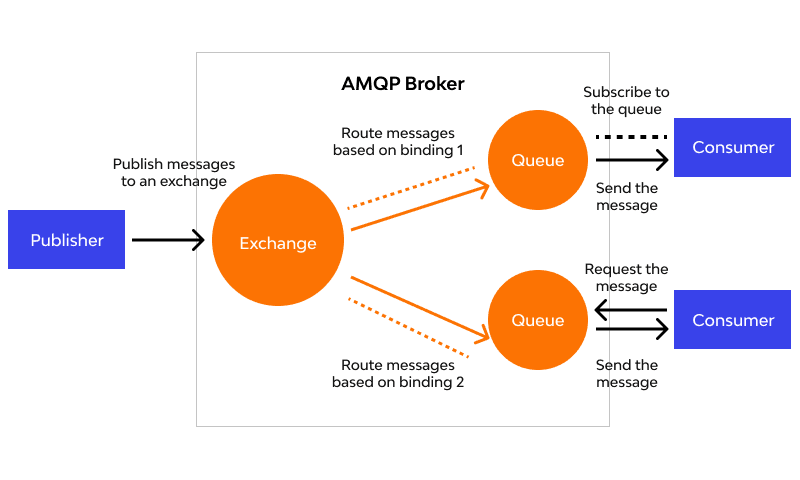
Exchange Types
- Direct: exact‑match routing key → queue
- Fanout: broadcast to all bound queues
- Topic: pattern‑match (
*single‑level,#multi‑level) - Headers: route by header attributes (
allorany)
Basic Workflow
- Producer → Exchange (provides routing key)
- Exchange → bound Queue(s) (based on type & bindings)
- Consumer pulls (or is pushed) messages from Queue
CoAP (Constrained Application Protocol)
-
Lightweight HTTP‑like protocol for resource‑constrained devices
-
Designed for M2M / IoT: minimal overhead, low power, small code footprint
-
Transport: UDP (low overhead)
-
Layer: Application
-
Model: Client ↔ Server (RESTful)
-
Resources: URI-based (
coap://…) -
Methods:
GET,POST,PUT,DELETE
“Constrained” Design Goals
- Small header: 4‑byte base, optional tokens/options
- Low memory & CPU usage
- Minimal message size
- Simple parsing
Messaging Types
| Type | Code | Reliability |
|---|---|---|
| CON | Confirmable | Retransmit until ACK received |
| NON | Non‑confirmable | Fire‑and‑forget (no ACK) |
| ACK | Acknowledgement | Acknowledges a CON or piggybacks a response |
| RST | Reset | Rejects a message or signals error |
XMPP (Extensible Messaging & Presence Protocol)
What & Why
- XML-streaming, client-server protocol for real-time messaging and presence
- Highly extensible via XEPs (XMPP Extension Protocols)
Core Concepts
- Stanzas (XML fragments):
<message/>– chat or data payload<presence/>– advertise online/offline/busy status<iq/>(“info/query”) – request/response for roster, vCard, service discovery
- Roster – contact list with subscription rules
- Presence – publish and subscribe to status changes
- Multi‑user chat, file transfer, voice/video (via Jingle XEPs), IoT pub/sub
Key Features
- Decentralized (federated) servers
- Extensible namespace model
- Built‑in trust (TLS), pluggable auth (SASL)
- “Long‑lived” XML streams with heartbeats (XMPP keep‑alive)
Use Cases
- Instant messaging, presence services
- IoT signaling (lightweight pub/sub)
- Collaboration (voice/video conferencing)
DDS (Data Distribution Service)
What & Why
- Broker‑less, peer‑to‑peer pub/sub middleware standardized by OMG
- Designed for high‑performance, real‑time M2M data exchange
- Eliminates single‑point failures via distributed discovery
Architecture Layers
- DCPS (Data‑Centric Publish‑Subscribe)
- Topics, DataWriters (publishers), DataReaders (subscribers)
- QoS policies: reliability, durability, deadline, liveliness, latency
- DLRL (Data Local Reconstruction Layer)
- In‑memory data caching and access patterns
Key Characteristics
- No Broker: peers discover each other via RTPS (Real‑Time Pub/Sub)
- Fine‑Grained QoS: control over delivery, ordering, resource use
- Scalable & Fault‑Tolerant: dynamic domain discovery, multicast support
- Language & OS Agnostic: C/C++, Java, Python, etc.
Use Cases
- Industrial automation & SCADA
- Autonomous vehicles & robotics
- Defense, aerospace, healthcare monitoring
SCADA (Supervisory Control & Data Acquisition)
Definition: A centralized system for real‑time monitoring and control of industrial processes.
Key Functions:
- Data Acquisition: Polling field devices at set intervals
- Real‑Time Monitoring: Displaying live values, trends, alarms
- Remote Control: Start/stop or adjust set‑points on equipment
- Alarm Management & Logging: Alert on thresholds, store historical data
Use Cases: Power grids, water/wastewater treatment, oil & gas pipelines, manufacturing lines
IIoT (Industrial Internet of Things)
The application of IoT technologies (sensors, connectivity, analytics) to industrial environments.
Key Capabilities:
- M2M Connectivity: Reliable device‑to‑device sync & communication
- Real‑Time Analytics: Defect/problem detection before failures
- Predictive Maintenance: Condition‑based servicing
- Digital Twins: Virtual replicas for simulation & optimization
Primary Benefits:
- ↓ Manual errors
- ↓ Time & operational costs
- ↑ Efficiency & throughput
- ↑ Safety via automated alerts
- Faster, data‑driven business decisions
Autonomous Vehicle
- Level 0 – No Automation
Driver does all steering, acceleration & braking. - Level 1 – Driver Assistance
System assists with either steering or speed control (e.g. adaptive cruise control or lane‑keep). - Level 2 – Partial Automation
System controls both steering and acceleration/braking simultaneously; driver must monitor and intervene. - Level 3 – Conditional Automation
System drives under defined conditions (e.g. highway); driver must be ready to take over. - Level 4 – High Automation
System handles all driving tasks in its operational design domain; human intervention optional. - Level 5 – Full Automation
System drives everywhere, in all conditions—no human driver needed.
Arduino and Raspberry Pi
Arduino
- Open source H/W & S/W platform
- Consists of a circuit board + ready made S/W (Arduino IDE)
- Uses simplified version of C++
- No extra hardware required on load code onto board, just use USB cable.
Raspberry Pi
- Single Board Computer (SBC) - consists of processor, memory, I/O interface on single circuit board.
- Uses - Gaming, Editing, Browsing, home automation, detectors, etc.
- Developed by Raspberry Pi Foundation
- Small in size and affordable
| Feature | Arduino Uno | Raspberry Pi 4 |
|---|---|---|
| Core | ATmega328P 8‑bit MCU @ 16 MHz | Broadcom BCM2711 64‑bit SoC @ 1.5 GHz quad‑core |
| Memory & Storage | 2 KB SRAM, 32 KB Flash; no SD slot | 1 – 8 GB RAM; microSD boot & storage |
| I/O | 14 digital I/O (6 PWM), 6 analog | 26 GPIO (digital); needs external ADC |
| OS | Bare‑metal (no OS) | Linux‑based (Raspbian, Ubuntu, etc.) |
| Programming | C/C++ via Arduino IDE | Python, C/C++, Java, Node.js, etc. |
| Power & Voltage | ~0.2 W @ 5 V; 5 V logic | ~3 W @ 5 V; 3.3 V logic |
| Connectivity | USB for programming; shields optional | USB, HDMI, Ethernet, Wi‑Fi, Bluetooth |
| Use Cases | Real‑time sensor/actuator control | Multimedia, networking, edge computing |
| Cost | $20 – $30 | $35 – $75 |
Tip: Use Arduino when you need real‑time I/O and simplicity; choose Raspberry Pi for full‑fledged OS, networking, and heavier compute tasks.
Reverse Engineered Assignments
Assignment 0
- RFID (Radio-Frequency Identification)
- Automatically identifies and tracks tags on objects via electromagnetic fields.
- Extracts information without direct line of sight.
- Zigbee Protocol Stack
- Physical
- Medium Access Control (MAC)
- Network
- Application
- Cloud-Computing Components
- Clients (end-user devices)
- Services (e.g. IaaS, PaaS, SaaS)
- Applications
- Platform, Storage, Infrastructure
- Not: Local servers
- Common Sensor Modules
- HC-SR04: Ultrasonic distance sensor (2 cm – 450 cm)
- DHT22: Temperature & humidity sensor
- TSL2591: Ambient light sensor
- HC-SR505: PIR motion sensor
- Typical Sensor-Network Components
- Sensor nodes (data sources)
- Routers (forward data)
- Gateways (protocol translation)
- Sink (data aggregation point)
- Measuring Orientation & Angular Velocity
- Gyroscope: correct device
- Accelerometer measures linear acceleration; GPS gives position
- ISA100.11a Standard
- ISA = International Society of Automation
- Defines wireless networking for industrial automation
- Traditional Data Center vs. Cloud
- Key differences: Scalability, Flexibility, Elasticity, Automation, Running Costs, Security
- Not a differentiator: Storage
- Smart Grid
- Also known as the Energy Internet
- Point-of-Node Failure
- In a stationary sensor network, a single-node failure can partition the network into fragments
Assignment 1
1. What Is IoT?
- Full Form: Internet of Things
- Evolution Drivers:
- Low-power embedded systems
- Cloud computing
- Big Data analytics
- Machine Learning
- Networking technologies
2. Enabling Technologies
- RFID: Radio-frequency tags for automatic identification and tracking
- Nanotechnology: Miniaturization of sensors, MEMS devices
- Sensors: Transducers converting physical parameters to electrical signals
- Smart Networks: IP-based, self-configuring communication backbones
3. IoT LAN vs. Gateway Functions
- IoT LAN (Local Area Network)
- Short-range, local communication within buildings or campuses
- Manages device discovery, data aggregation
- Gateway
- Bridges IoT LAN to wide-area/internet
- Handles protocol translation, security, QoS
- Not a LAN Function: long-range/global or world-wide connectivity
4. IPv6 Addressing & Multi-Homing
4.1 Address Crunch
- Occurs when legacy, smart and constrained nodes share the same IP space
4.2 Multi-Homing
- Definition: Connecting a node or network to multiple networks for redundancy and reliability (not single)
- Approaches:
- Proxy-based: A proxy server manages multiple interfaces
- Gateway-based: A dedicated gateway routes traffic across links
4.3 IPv6 Notation
- Format: Hexadecimal fields separated by colons. e.g.
2001:0db8:85a3::8a2e:0370:7334 - Length: 128 bits total (8 groups × 16 bits)
5. Sensing Fundamentals
- Sensor Characteristics:
- Selective Sensitivity: Only responds to its target measurand
- Insensitivity: Ignores other physical properties
- Classification by Output:
- Analog Sensors: Continuous voltage/current proportional to measurand
- Digital Sensors: Output discrete digital values (e.g. via ADC)
- Data Flow: Sensor readings can be transmitted to the cloud for storage, analytics, ML processing
6. Actuation Basics
- Relays
- Electromechanical switches (actuators)
- Use low-voltage DC to switch higher-voltage AC loads
- Soft Actuators
- Polymer-based materials that deform under stimuli (electric field, pressure)
- Enable gentle, bio-inspired motion
Assignment 2
1. MQTT (Message Queuing Telemetry Transport)
- Type: Data-protocol optimized for IoT
- Use Cases:
- Remote (often intermittent) connections
- Constrained/low-bandwidth networks
- Architecture:
- Publish–Subscribe paradigm (event-driven)
- Underpinned by a lightweight Client–Server model
- Core Components:
- Publisher: Sends messages to topics
- Subscriber: Receives messages from topics
- Broker: Routes messages based on topic filters
- Topics:
- UTF-8 strings (not numeric only)
- Act as routing keys within the broker
- Message Methods:
- Five defined MQTT control packet types (CONNECT, PUBLISH, SUBSCRIBE, etc.)
2. CoAP (Constrained Application Protocol)
- Based On: HTTP semantics adapted for IoT
- Designed For: Machine-to-Machine (M2M) applications, constrained devices
- Transport: Asynchronous client–server over UDP (datagram)
3. AMQP (Advanced Message Queuing Protocol)
- Full Form: Advanced Message Queuing Protocol
- Purpose: Standardized, reliable message-oriented middleware
- Frame Types: 9 distinct frame structures for control, data transfer, and management
4. OSI Model
- Layers (from bottom up):
- Physical
- Data Link
- Network
- Transport
- Session
- Presentation
- Application
- Purpose: Conceptual framework to standardize network communication
5. IPv4 Packet: Destination Address
- Definition: 32-bit field identifying the final recipient node in the network
- Not:
- Source address of the packet
- Intermediate hop address
Assignment 3
1. HART Protocol
1.1 Overview
- HART = Highway Addressable Remote Transducer
- Designed for digital communication over legacy 4–20 mA wiring
1.2 Wired vs. Wireless HART
| Feature | Wired HART | WirelessHART |
|---|---|---|
| Physical Layer | Proprietary FSK over 4–20 mA loop | IEEE 802.15.4-based DSSS @ 2.4 GHz |
| Data Link Layer | Time-division and master-slave logic | TDMA with channel-hopping for determinism and collision-freedom |
| Network Layer | Not present | Mesh routing for multi-hop connectivity |
| Application Layer | Command/response framing | Same HART commands over the mesh; extracts, executes, responds |
- Key Points:
- WirelessHART is the latest HART release, adding network-layer mesh routing.
- Operates exclusively in the 2.4 GHz ISM band.
- Deterministic, collision-free scheduling via TDMA & channel hopping.
2. NFC (Near Field Communication)
2.1 Principles & Range
- Communication by magnetic induction between coils in close proximity (typically < 10 cm).
- Passive NFC tags: Contain information; are unpowered and read by an active device.
- Active NFC devices: Generate their own RF field for two-way communication.
2.2 Use Cases & Characteristics
- Contactless payments, electronic ticketing, access control
- Low data rates (106–424 kbps), ultra-short range for security
- Simple pairing (tap-to-connect) without manual configuration
3. Bluetooth
3.1 Architecture
- Based on ad-hoc piconets:
- One master, up to seven active slaves per piconet
- Can interconnect piconets into scatternets
3.2 Protocol Stack Highlights
- Link Manager Protocol (LMP):
- Manages link establishment, authentication, encryption, and configuration (not just authentication).
- L2CAP: Multiplexes higher-layer protocols, segmentation/reassembly
- RFCOMM: Serial-port emulation
- HCI: Hardware abstraction to controller
3.3 PHY & MAC
- 2.4 GHz ISM band; uses frequency-hopping spread spectrum (FHSS)
- Data rates: Classic Bluetooth up to ~3 Mbps; BLE up to 2 Mbps
4. Zigbee (IEEE 802.15.4-Based)
4.1 Key Properties
- PHY/MAC: Defined by IEEE 802.15.4 @ 2.4 GHz
- Data Rate: 250 kbps
- Topology: Star, tree, and mesh networks
4.2 Application Layer
- Profiles for home automation, smart energy, health care
- Low-power, low-cost, and support for large mesh deployments
Assignment 4
1. Agricultural IoT Deployment (AID)
- Definition: Deploying a grid of static sensor nodes across an agricultural field to monitor environmental parameters (e.g., soil moisture, temperature, humidity).
- Use Cases: Precision irrigation, pest detection, crop health monitoring
2. Ultrasonic Distance Sensing
- Principle: Emits ultrasonic pulses and measures echo return time; distance = (speed of sound × round-trip time)/2.
- Typical Specs:
- Range: 2 cm to several meters (depending on sensor)
- Resolution: millimeter-scale
- Applications: Obstacle detection, liquid-level measurement, presence sensing.
3. Coverage in Static Wireless Sensor Networks (WSNs)
3.1 Coverage Problem
- Definition: Determining optimal placement (and activation) of static sensors so that every point/area of interest is “covered” by at least one sensor’s sensing radius.
3.2 Coverage Objectives
- Minimize Sensor Count: Reduce hardware cost and deployment complexity
- Maximize Network Lifetime: Conserve energy by avoiding redundant coverage and rotating active sensors
3.3 Coverage Types
- Area Coverage: Entire region must be within sensing range of ≥1 node
- Point Coverage: Specific targets or locations need monitoring
- Barrier Coverage: Creating a “fence” so that any crossing path intersects at least one sensor’s coverage disk
3.4 Coverage Disk Model
- Crossing Covered: A path “crossing” is covered if its trajectory passes through the interior of at least one node’s circular sensing region.
4. Stationary WSN Characteristics
- Static Topology: Nodes remain fixed after deployment; no self-reconfiguration
- Failure Impact: A single node failure can partition the network into disconnected segments, affecting coverage and routing
5. UAV (Unmanned Autonomous Vehicle) Networks
5.1 Key Features
- Multi-Tasking: UAVs can carry multiple sensors or perform varied missions in one flight
- Large Coverage Area: High altitude and mobility allow monitoring over wide regions
- Scalability: Easily add or remove UAVs to adjust coverage or data-gathering capacity
5.2 Network Topologies
- Star: All UAVs communicate through a central ground station or leader UAV
- Mesh: UAVs relay data peer-to-peer, extending range and resilience
6. Mobile WSN & Data Mules
- Data Mule Concept: Mobile entities (e.g., vehicles or robots) collect buffered data from static sensors, then transport and offload it at a sink node.
- Collect Phase: Visit sensor nodes within communication range
- Delivery Phase: Return to sink to offload accumulated readings
- Advantages: Reduces need for multi-hop forwarding; conserves sensor energy
7. Autonomous Underwater Vehicles (AUVs)
- Full Form: Autonomous Underwater Vehicle
- Role: Untethered platforms for deep-water sensing (e.g., oceanographic data, pipeline inspection)
8. Human-Centric Sensing
- Definition: Harnessing sensors embedded in personal devices (smartphones, wearables) carried by humans to collect context-aware data.
- Major Challenges:
- Energy Management: Balancing battery life with continuous sensing
- Participant Selection: Incentivizing and choosing appropriate users/devices for reliable data streams
9. Machine-to-Machine (M2M) Application Platforms
- Purpose: Provide end-to-end services (device management, data analytics, visualization) by integrating heterogeneous device datasets.
- Examples: Remote asset monitoring, smart metering dashboards, predictive maintenance systems
Assignment 5
1. Current Challenges in IoT
- Large-Scale Cooperation
- Billions of heterogeneous devices must coordinate, share data, and collaborate seamlessly.
- Examples: Smart cities integrating traffic lights, parking sensors, public transport feeds.
- Global Heterogeneity
- Diverse hardware platforms (sensors, gateways), communication protocols (MQTT, CoAP, HTTP), and software stacks (JavaScript, Python, Java).
- Requires common interfaces and translation layers for cross-domain interoperability.
2. Interoperability in IoT
2.1 Definition
Interoperability is the ability of two or more systems or components to exchange information and use the exchanged information effectively.
2.2 Why It Matters
- Protocol Diversity: Devices use different network stacks (e.g., BLE, LoRaWAN, Wi-Fi).
- Language Diversity: Firmware and cloud code written in various languages (C/C++, Python, JavaScript).
- Data Formats: JSON, XML, binary payloads, proprietary encodings.
2.3 Levels of Interoperability
| Level | Description | |
|---|---|---|
| Syntactic | Common message formats/schemas (e.g., JSON over MQTT) | |
| Semantic | Shared vocabularies or ontologies so that “temp” on Device A means the same as “T” on B | |
| Systemic | End-to-end service integration, including workflows, user interfaces, and business logic |
2.4 Middleware Solutions
UMB (Universal Middleware Bridge):
- Acts as a translation hub between disparate IoT platforms and protocols.
- Handles protocol adaptation, data-model mapping, authentication brokering.
3. Arduino: The Open-Source MCU Platform
3.1 Overview
- Arduino: A family of easy-to-use microcontroller boards and IDE for rapid prototyping.
- Open-Source: Schematics and code libraries are publicly available.
3.2 Hardware Highlights (Arduino Uno)
- Microcontroller: ATmega328P @ 16 MHz
- Digital I/O Pins: 14 total (0–13), configurable as input or output
- Analog Inputs: 6 channels (A0–A5)
- On-Board USB for programming and serial comms
- No External Circuitry Needed to upload sketches—just USB cable and IDE.
4. Arduino Programming Fundamentals
4.1 Sketch Structure
void setup() {
  // Runs once at startup
}

void loop() {
  // Runs repeatedly
}
4.2 Control Flow: Loops
- for loop
for (int i = 0; i < N; i++) { /* ... */ } - while loop
while (condition) { /* ... */ } - do-while loop
do { /* ... */ } while (condition);
Arduino supports all three C-style loops.
4.3 Conditional (Ternary) Operator
value = (condition) ? expressionIfTrue : expressionIfFalse;5. Example: LED Blink Sketch
int ledPin = 13;

void setup() {
  pinMode(ledPin, OUTPUT);
  for (int i = 0; i < 3; i++) {
    digitalWrite(ledPin, HIGH);   // LED ON
    delay(1000);                  // wait 1000 ms
    digitalWrite(ledPin, LOW);    // LED OFF
    delay(500);                   // wait 500 ms
  }
}

void loop() {
  // nothing else
}- Behavior: Blinks the on-board LED three times, each ON for 1 s and OFF for 0.5 s.
6. Interfacing Sensors & Actuators
6.1 DHT Temperature & Humidity Sensor
- Library Initialization
<span style={{ color: 'rgb(116,62,228)' }}>#include</span> <DHT.h> DHT dht(pin, DHTTYPE); void setup() { dht.begin(); // Start communication with DHT sensor } - Reading Values
float h = dht.readHumidity();     // %RH
float t = dht.readTemperature();  // °C
dht.begin()must be called before any readings to initialize timing and data pins.
6.2 Servo Motor Control
- Moving to Angle
<span style={{ color: 'rgb(116,62,228)' }}>#include</span> <Servo.h>
Servo myServo;

void setup() {
  myServo.attach(pin);
  myServo.write(90);  // Move to 90°
}
ServoDemo.write()(i.e.,myServo.write()) sets the shaft angle in degrees (0–180°).
Assignment 6
1. Python for Embedded Development
- Lightweight language: Python’s interpreter and libraries are small enough to run on microcontrollers and SBCs like Raspberry Pi, making it popular for embedded apps.
- Indentation: Blocks are defined by consistent indentation (usually 4 spaces); no braces.
2. Common Python Operations
- File I/O Modes
'r': read (error if file missing)'w': write, truncate existing content or create new'a': append to end'r+': read/write without truncating
3. Working with Sensors & Libraries
- DHT22 sensor: Use Adafruit’s CircuitPython library (
adafruit_dht) to read temperature/humidity. - PIL (Pillow): Install to get the updated fork of the old PIL image library.
sudo pip install pillow
4. Raspberry Pi Networking & Services
- Remote Access (client side): Needs both the server’s IP address and port number to connect via sockets/SSH.
- File Server: Raspberry Pi can be configured as a Samba or NFS file server to share storage on the network.
5. Raspberry Pi Configuration & Camera
- Configure camera:
sudo raspi-config
→ Enable camera interface → Reboot the Pi.
- Capture still image:
raspistill -o image.jpg
6. Nano Editor Shortcuts
- Exit nano:
Ctrl + X - Save (write out):
Ctrl + O - Cut line:
Ctrl + K
7. IoT Control Logic
- Relay‐controlled fan: Fan turns ON when surrounding temperature exceeds a predefined threshold; turns OFF otherwise.
Assignment 7
1. Python Socket Programming
-
Socket Types
SOCK_STREAM→ TCP socket typeSOCK_DGRAM→ UDP socket type
-
Address Families
AF_INET→ IPv4 Internet protocolsAF_INET6→ IPv6
-
Basic Server Workflow
sock = socket.socket(AF_INET, SOCK_STREAM) sock.bind((host, port)) sock.listen(backlog) # Waits for incoming client connections conn, addr = sock.accept().listen()makes the socket wait for clients
-
UDP vs TCP Receive
- TCP:
data = sock.recv(bufsize) - UDP:
data, addr = sock.recvfrom(bufsize)
- TCP:
2. Plot Customization with Matplotlib
- Set Y-axis label
import matplotlib.pyplot as plt
plt.ylabel("Temperature (°C)")
3. SDN Fundamentals
- Mobi-Flow Protocol
- Extends SDN to support mobility in wireless networks
- Control-Data Plane Messages
- PACKET_OUT: sent from controller to switch to inject/forward a packet
- Flow Rules vs Routing Tables
- Traditional Network → Routing Table
- SDN → Flow Table
- Time-outs in Flow Rules
- Soft time-out: idle timeout (removes rule if no matching packets seen)
- Hard time-out: absolute timeout (removes rule after fixed time)
- Hard time-out ≥ Soft time-out
- Rule Placement Issue
- Deciding which switches get which flow rules is the Flow Rule Placement problem
- APIs in SDN
- Northbound: controller → applications
- Southbound: controller → switches
- East-Westbound: controller ↔ controller (for multi-controller setups)
- Hierarchical (Tree) SDN Architecture
- Also called Tree architecture, with higher-level controllers managing lower ones
- SDN & IoT
- Integration is recommended: centralizes policy, simplifies management, scales better
Assignment 8
1. SDN in IoT
Sensor OpenFlow
- A variant of the OpenFlow SDN protocol specifically optimized for resource-constrained IoT devices.
Mobi-Flow
- Purpose: A flow-rule placement scheme that tracks mobile IoT nodes and proactively installs/removes rules to minimize control-plane chatter.
- Message overhead:
- Mobi-Flow < Conventional: By pre-empting handovers, it reduces the number of flow-mod and packet-in messages compared to a naive approach .
- Where used: Mobility-aware SDIoT setups (e.g., mobile asset tracking in a factory).
2. Virtualization & Cloud Foundations
Virtual Machines → Cloud
- Order of emergence:
- Virtual Machines (1960s–80s): software “boxes” emulating entire OSes on a host.
- Cloud Computing (2000s): on-demand delivery of compute/storage over the Internet, built on VM farms .
Cloud Deployment Models
| Model | Description | Use-case |
|---|---|---|
| Private | Dedicated infra on-premise or in a private data center | High security/regulatory requirements |
| Public | Shared infra run by third-party provider (AWS, Azure, GCP) | Variable workload, cost-efficiency |
| Hybrid | Mix of both: sensitive data on private; bulk workloads on public | Data locality + scalability (e.g., keep PII on-premise, archive logs to public cloud) |
3. Cloud Service Models
| Service | What’s delivered | Example |
|---|---|---|
| IaaS | Raw VMs, storage volumes, networking | AWS EC2, Google Compute |
| PaaS | Runtime environment (OS + middleware + app-hosting APIs) | Heroku, Google App Engine |
| SaaS | Complete applications accessed over network | Salesforce CRM, Spotify Web |
- Spotify Web: You stream music via browser without installing—classic SaaS .
4. Client Types
- Thin Client:
- Minimal local resources (no HDD, little RAM/CPU)
- Depends on server for app execution; needs constant network connectivity .
- Thick (Fat) Client:
- Rich local resources, can run apps offline.
5. Cloud Security Essentials
CIA Triad
- Confidentiality: only authorized users/data access
- Integrity: data isn’t tampered or corrupted
- Availability: systems/data accessible when needed
Security Layers
- Network-level: firewalls, VPNs
- Host-level: HIDS/HIPS on VMs
- Application-level: secure coding, WAFs
- All three are required for robust defense
Model-wide Issues
- Data security & client auth are challenges in all three service models (IaaS, PaaS, SaaS) because attackers can target any layer .
6. Hypervisor
- Role: Software layer that creates and runs virtual machines (VMs) by abstracting hardware.
- Types:
- Type 1 (“bare-metal”) runs directly on host hardware (e.g., VMware ESXi, Xen).
- Type 2 runs atop a host OS (e.g., VirtualBox, VMware Workstation) .
7. SaaS Limitations
- Centralized control:
- Pros: uniform updates, single-pane management
- Cons: single provider → potential vendor lock-in, less tenant customization
8. Key Term
- Ubiquitous: independent of device or location (e.g., cloud services accessible from any Internet-connected device) .
Assignment 9
1. Cloud Computing Advantages
- Elasticity – Dynamically scale resources up/down on demand
- Pay-per-use – Only billed for actual resource consumption
- Self-service – Users provision services via portals/APIs without admin help
2. Fog Computing
- Definition: Middleware layer between Cloud and edge devices that runs services closer to sensors/actuators
- Role: Reduces latency, offloads bandwidth, supports real-time analytics
3. Sensor-Cloud Architecture
- Managerial role: Handled by the Sensor-Cloud Service Provider (they own, allocate, and monitor virtualized sensors)
- Principal feature: Sensor virtualization – abstracts physical sensors into on-demand virtual instances
4. OpenStack Components
- Core services:
- Nova – Compute (VM provisioning)
- Swift – Object storage
- Glance – VM image service
- Neutron – Networking
- Heat – Orchestration (stack templates)
- Horizon – Web dashboard (access point for all components)
5. Origins & Concepts
- “Fog computing” coined by: Cisco
- Hardware virtualization: Enables sharing of physical hardware among multiple VMs/tenants, forming the foundation of all cloud models
6. IoT Data Characteristics
- Temporal sensitivity matters:
- Time-sensitive: real-time control (e.g., autonomous vehicles)
- Less sensitive: periodic monitoring
- Not time-sensitive: bulk analytics
7. Sensor-Cloud Management Issues
- Optimal composition of virtual sensors: Deciding how many and which virtual instances serve client demands
- Caching mechanisms (2 types):
- Internal Cache (IC): within the sensor-cloud platform
- External Cache (EC): at edge/fog nodes
8. Latency Calculation Example
- Given: One-way network delay = 10 s; processing time = x; total round-trip = 25 s
- Equation: 25 = 10 + x + 10 → x = 5 s
9. Fog vs Cloud
- Complementary: Fog extends cloud by handling latency-critical tasks at the edge; not a replacement
Assignment 10
1. Smart City Active Entities
- Police stations, banks, transport hubs, etc., all act as active connected nodes in a holistic smart-city ICT fabric .
2. Citizen Engagement
- ICT tools (mobile apps, e-portals, social media) boost participation in governance—surveys, e-voting, service requests—all in real time .
3. Smart Parking Challenges
- Auto-routing vehicles to spots
- Detecting available spaces reliably
- Automated charging for EVs
- → A full smart-parking solution must tackle all of these .
4. Multi-Sensor Data Fusion
- Definition: Combining streams from different sensors into a unified estimate
- Key theory: Belief functions (Dempster–Shafer) let you mathematically fuse uncertain evidence.
- Challenge: Outliers (faulty or malicious readings) can skew the fusion result; detection and filtering are crucial.
5. Intelligent Connected Vehicles (ICV) Phases
- Cellular-based telemetry (2G)
- High-speed data links (4G LTE)
- Cloud-connected vehicles exchanging data/platform services.
6. Decision-Making Gap
- Bridged by AI: Machine-learning/edge-AI modules can autonomously interpret sensor data and trigger actuator commands with minimal latency.
7. Home Area Network (HAN) Standards
- IEEE 802.15.4: Physical & MAC
- Zigbee: Network & Application
8. UPnP
- Universal Plug and Play: Zero-config network discovery/protocol for device interoperability (printers, media servers) .
9. V2X (Vehicle-to-Everything) Communication
- Disadvantage: Movement tracking risk → privacy concerns .
- Mobility limits TCP/IP: IP routing assumes relatively stable endpoints; highly mobile vehicles break that assumption .
10. VANET Dynamics
- Link durations are short: High relative speeds make connections brief—contrary to static network assumptions .
11. Content-Centric Networking
- CCN is a realization of ICN principles: data is addressed by name rather than location, ideal for dynamic IoT/V2X content delivery .
12. Cooperative ICV Safety
- Vehicles sharing trajectory, road-hazard, and proximity data enable collision avoidance and smoother traffic flow—proven to reduce accidents .
Assignment 11
1. Smart Grid Overview
- Core use-case: Intelligent power plants with bidirectional energy flow (generation ↔ consumers) .
- Stakeholders: Both service providers (utilities) and consumers benefit via efficiency, real-time pricing, outage detection .
- Load forecasting: Feasible using historic usage data, weather, and demand models to balance supply/demand .
2. Architecture & Integration
- IP Network role: Globally interconnects grid components—RTUs, SCADA centers, smart meters—for seamless data exchange .
- Smart Home synergy: Not isolated—homes can inject stored solar power back to grid and respond to demand-response signals .
3. Cloud Applications & Vulnerabilities
- Smart-Grid cloud apps:
- Information management (meter data analytics)
- Energy management (dynamic load control)
- Security (intrusion detection, anomaly alerts)
- Vulnerabilities:
- Integrity breaches (false data injection)
- Physical threats (tampering RTUs)
- Dynamic system attacks (smart-relay exploits)
4. IIoT (Industrial IoT)
- Revolution stage: IIoT is hallmark of the 4th Industrial Revolution, blending cyber-physical systems with Big Data & AI .
- Data intensity: Generates massive streams—sensor telemetry, machine logs—requiring edge processing & cloud analytics .
- Key utility: Power-plant virtualization—modeling plant behavior in software to optimize dispatch and maintenance remotely .
5. Data Lifecycle & Management
- Data flow:
- Generation (sensors, meters)
- Acquisition (gateways, edge nodes)
- Storage (time-series DBs, data lakes)
- Analysis (predictive analytics, dashboards) .
- Unstructured data: ~ 80% of world’s data (logs, images, sensor blobs) – drives need for NoSQL and distributed file systems .
- SQL vs NoSQL: SQL excels at structured (tabular) data; use NoSQL for flexible schemas and unstructured streams.
6. Intelligent Transport System (ITS)
- Connectivity modes: V2V, V2S (sensors), V2I (infrastructure), but not typically V2H (home) in ITS scope .
Assignment 12
1. Qualitative vs Quantitative
- Qualitative analysis: examination of non-numerical data (e.g., interviews, observations).
- Quantitative analysis: statistical treatment of numerical data.
2. Statistical Techniques
- ANOVA (Analysis of Variance)
- Tests mean differences across ≥2 groups by comparing between-group to within-group variance.
- Assumptions:
- Homogeneity of variances
- Normally distributed response
- Independence of observations
- Types: One-way, Two-way, K-way .
- Regression Analysis
- Models relationship: predicts dependent variable from one/more independent variables .
- ARIMA
- Time-series forecasting (uses AutoRegressive & Moving Average components + differencing).
- Effect Size
- Standardized mean difference between groups; complements p-values by quantifying magnitude .
3. Dispersion Measures
- Range: Max – Min
- Variance: Average squared deviation from the mean .
4. IoT Analytics Approaches
- In-place processing: Data is processed on the device (edge analytics), reducing latency and bandwidth use .
- Network-based: Data sent to cloud/fog for processing.
5. Case Study: AgriSens Architecture
- Three logical layers:
- Perception (sensors: soil moisture, water level)
- Processing (edge nodes, gateways)
- Application (dashboards, alerts) .
- Real-time monitoring: Soil moisture readings streamed to dashboard for instant irrigation control .
6. Smart Healthcare Data Aggregator
- Known as LPU (Local Processing Unit) — collects & pre-processes patient sensor data before cloud uplink .
- AmbuSense: Privacy-aware system with patient identity masking built in .
7. Wearable AI Use-Case
- Fall detection: Handheld/activity-monitoring device uses onboard AI on accelerometer/gyroscope streams to detect sudden drops .
8. Motion Sensing
- Gyroscope: Detects device tilt/rotation (e.g., 15° tilt) .
- Accelerometer: Measures linear acceleration; can infer orientation but less precise for angular velocity.